When Did the Center of the Western Art World Shift From Europe to the United States
| Years active | Tardily 1940s to present |
|---|---|
| State | United States, specifically New York City |
| Major figures | Jackson Pollock, Willem de Kooning, Arshile Gorky, Mark Rothko, Lee Krasner, Robert Motherwell, Franz Kline, Adolph Gottlieb, David Smith, Hans Hofmann, Joan Mitchell |
| Influences | Modernism, Surrealism, Cubism, Dada |
Abstract expressionism is a post–World War II fine art movement in American painting, developed in New York City in the 1940s.[1] Information technology was the starting time specifically American movement to achieve international influence and put New York at the center of the Western art globe, a role formerly filled by Paris.
Although the term "abstract expressionism" was showtime applied to American fine art in 1946 past the art critic Robert Coates, it had been outset used in Federal republic of germany in 1919 in the mag Der Sturm, regarding German Expressionism. In the U.s.a., Alfred Barr was the commencement to use this term in 1929 in relation to works by Wassily Kandinsky.[ii]
Style [edit]
Technically, an important predecessor is surrealism, with its emphasis on spontaneous, automatic, or subconscious cosmos. Jackson Pollock'south dripping paint onto a canvas laid on the floor is a technique that has its roots in the work of André Masson, Max Ernst, and David Alfaro Siqueiros. The newer research tends to put the exile-surrealist Wolfgang Paalen in the position of the artist and theoretician who fostered the theory of the viewer-dependent possibility space through his paintings and his magazine DYN. Paalen considered ideas of quantum mechanics, as well every bit idiosyncratic interpretations of the totemic vision and the spatial structure of native-Indian painting from British Columbia and prepared the ground for the new spatial vision of the young American abstracts. His long essay Totem Art (1943) had considerable influence on such artists every bit Martha Graham, Isamu Noguchi, Pollock, Mark Rothko and Barnett Newman.[3] Around 1944 Barnett Newman tried to explain America'due south newest art motility and included a list of "the men in the new movement." Paalen is mentioned twice; other artists mentioned are Gottlieb, Rothko, Pollock, Hofmann, Baziotes, Gorky and others. Robert Motherwell is mentioned with a question mark.[4] Another important early on manifestation of what came to be abstract expressionism is the work of American Northwest creative person Marking Tobey, particularly his "white writing" canvases, which, though by and large not big in calibration, anticipate the "all-over" look of Pollock'south drip paintings.
The motion'south name is derived from the combination of the emotional intensity and self-deprival of the German language Expressionists with the anti-figurative aesthetic of the European abstract schools such every bit Futurism, the Bauhaus, and Constructed Cubism. Additionally, it has an epitome of being rebellious, anarchic, highly idiosyncratic and, some experience, nihilistic.[5] In do, the term is applied to any number of artists working (by and large) in New York who had quite dissimilar styles, and fifty-fifty to work that is neither peculiarly abstract nor expressionist. California abstract expressionist Jay Meuser, who typically painted in the not-objective style, wrote nearly his painting Mare Nostrum, "Information technology is far amend to capture the glorious spirit of the bounding main than to paint all of its tiny ripples." Pollock'south energetic "action paintings", with their "decorated" feel, are different, both technically and aesthetically, from the violent and grotesque Women serial of Willem de Kooning'southward figurative paintings and the rectangles of color in Rothko's Colour Field paintings (which are not what would usually exist called expressionist, and which Rothko denied were abstract). Yet all four artists are classified equally abstruse expressionists.
Abstruse expressionism has many stylistic similarities to the Russian artists of the early 20th century such as Wassily Kandinsky. Although it is truthful that spontaneity or the impression of spontaneity characterized many of the abstract expressionists' works, most of these paintings involved conscientious planning, particularly since their large size demanded information technology. With artists such as Paul Klee, Kandinsky, Emma Kunz, and after Rothko, Newman, and Agnes Martin, abstruse art clearly unsaid expression of ideas concerning the spiritual, the unconscious, and the heed.[6]
Why this style gained mainstream acceptance in the 1950s is a matter of debate. American social realism had been the mainstream in the 1930s. It had been influenced not only by the Cracking Depression, but too by the Mexican muralists such every bit David Alfaro Siqueiros and Diego Rivera. The political climate afterwards World War Ii did non long tolerate the social protests of these painters. Abstract expressionism arose during the war and began to be showcased during the early forties at galleries in New York such as The Fine art of This Century Gallery. The postal service-state of war McCarthy era was a time of artistic censorship in the Usa, only if the subject matter were totally abstract and so it would be seen as apolitical, and therefore safe. Or if the fine art was political, the bulletin was largely for the insiders.[7]
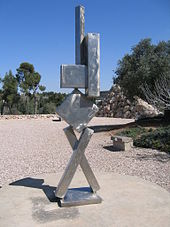
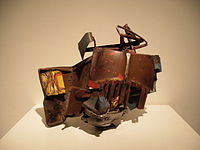
While the movement is closely associated with painting, collagist Anne Ryan and certain sculptors in detail were also integral to abstract expressionism.[8] David Smith, and his wife Dorothy Dehner, Herbert Ferber, Isamu Noguchi, Ibram Lassaw, Theodore Roszak, Phillip Pavia, Mary Callery, Richard Stankiewicz, Louise Conservative, and Louise Nevelson in detail were some of the sculptors considered as being of import members of the movement. In addition, the artists David Hare, John Chamberlain, James Rosati, Mark di Suvero, and sculptors Richard Lippold, Raoul Hague, George Rickey, Reuben Nakian, and fifty-fifty Tony Smith, Seymour Lipton, Joseph Cornell, and several others[nine] were integral parts of the abstract expressionist movement. Many of the sculptors listed participated in the 9th Street Show,[9] a famous exhibition curated past Leo Castelli on East Ninth Street in New York Metropolis in 1951. Besides the painters and sculptors of the period the New York School of abstruse expressionism as well generated a number of supportive poets, including Frank O'Hara and photographers such as Aaron Siskind and Fred McDarrah, (whose book The Artist'due south Globe in Pictures documented the New York School during the 1950s), and filmmakers—notably Robert Frank—also.
Although the abstruse expressionist school spread quickly throughout the Us, the epicenters of this style were New York City and the San Francisco Bay area of California.
Art critics of the post–World War Two era [edit]
At a certain moment the canvass began to appear to one American painter afterwards some other as an loonshit in which to act. What was to keep the canvas was not a picture but an outcome.
In the 1940s in that location were non only few galleries (The Art of This Century, Pierre Matisse Gallery, Julien Levy Gallery and a few others) but also few critics who were willing to follow the work of the New York Vanguard. In that location were also a few artists with a literary background, among them Robert Motherwell and Barnett Newman, who functioned every bit critics as well.
While the New York avant-garde was still relatively unknown by the late 1940s, most of the artists who have become household names today had their well-established patron critics: Clement Greenberg advocated Jackson Pollock and the color field painters like Clyfford Nevertheless, Mark Rothko, Barnett Newman, Adolph Gottlieb and Hans Hofmann; Harold Rosenberg seemed to prefer the action painters such every bit Willem de Kooning and Franz Kline, as well as the seminal paintings of Arshile Gorky; Thomas B. Hess, the managing editor of ARTnews, championed Willem de Kooning.
The new critics elevated their protégés past casting other artists as "followers"[11] or ignoring those who did non serve their promotional goal.
In 1958, Marking Tobey became the showtime American painter since Whistler (1895) to win top prize at the Venice Biennale.[12]
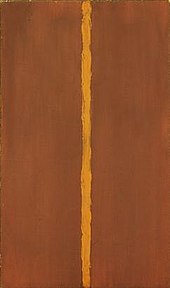
Barnett Newman, Onement 1, 1948. During the 1940s Barnett Newman wrote several articles about the new American painting.
Barnett Newman, a late member of the Uptown Group, wrote catalogue forewords and reviews, and by the tardily 1940s became an exhibiting artist at Betty Parsons Gallery. His offset solo show was in 1948. Shortly after his get-go exhibition, Barnett Newman remarked in 1 of the Artists' Sessions at Studio 35: "We are in the process of making the earth, to a sure extent, in our ain image."[13] Utilizing his writing skills, Newman fought every step of the way to reinforce his newly established image every bit an creative person and to promote his work. An instance is his letter on April nine, 1955, "Letter to Sidney Janis: — information technology is true that Rothko talks the fighter. He fights, however, to submit to the philistine world. My struggle against bourgeois society has involved the total rejection of it."[14]
Strangely, the person thought to have had most to do with the promotion of this manner was a New York Trotskyist: Cloudless Greenberg. As long-time art critic for the Partisan Review and The Nation, he became an early and literate proponent of abstract expressionism. The well-heeled artist Robert Motherwell joined Greenberg in promoting a fashion that fit the political climate and the intellectual rebelliousness of the era.
Greenberg proclaimed abstract expressionism and Pollock in particular as the epitome of artful value. He supported Pollock'south work on formalistic grounds as just the best painting of its 24-hour interval and the culmination of an art tradition going back via Cubism and Cézanne to Monet, in which painting became ever-'purer' and more concentrated in what was 'essential' to information technology, the making of marks on a flat surface.[fifteen]
Pollock'due south work has ever polarised critics. Rosenberg spoke of the transformation of painting into an existential drama in Pollock's work, in which "what was to keep the canvas was not a picture but an event". "The large moment came when it was decided to paint 'just to paint'. The gesture on the canvass was a gesture of liberation from value—political, aesthetic, moral."[16]
One of the nearly vocal critics of abstract expressionism at the fourth dimension was The New York Times art critic John Canaday. Meyer Schapiro and Leo Steinberg along with Greenberg and Rosenberg were important art historians of the mail service-state of war era who voiced support for abstract expressionism. During the early on-to-mid-sixties younger art critics Michael Fried, Rosalind Krauss, and Robert Hughes added considerable insights into the critical dialectic that continues to grow around abstract expressionism.
History [edit]
Earth War II and the Post-State of war catamenia [edit]
During the catamenia leading up to and during Globe War 2, modernist artists, writers, and poets, as well equally important collectors and dealers, fled Europe and the onslaught of the Nazis for prophylactic haven in the United States. Many of those who didn't abscond perished. Among the artists and collectors who arrived in New York during the war (some with help from Varian Fry) were Hans Namuth, Yves Tanguy, Kay Sage, Max Ernst, Jimmy Ernst, Peggy Guggenheim, Leo Castelli, Marcel Duchamp, André Masson, Roberto Matta, André Breton, Marc Chagall, Jacques Lipchitz, Fernand Léger, and Piet Mondrian. A few artists, notably Picasso, Matisse, and Pierre Bonnard remained in France and survived.
The postal service-war period left the capitals of Europe in upheaval, with an urgency to economically and physically rebuild and to politically regroup. In Paris, formerly the centre of European culture and capital of the art world, the climate for fine art was a disaster, and New York replaced Paris as the new center of the fine art world. Post-war Europe saw the continuation of Surrealism, Cubism, Dada, and the works of Matisse. Besides in Europe, Art brut,[17] and Lyrical Abstraction or Tachisme (the European equivalent to abstract expressionism) took concord of the newest generation. Serge Poliakoff, Nicolas de Staël, Georges Mathieu, Vieira da Silva, Jean Dubuffet, Yves Klein, Pierre Soulages and Jean Messagier, amongst others are considered important figures in mail service-war European painting.[eighteen] In the U.s.a., a new generation of American artists began to emerge and to dominate the world stage, and they were called Abstruse Expressionists.
Gorky, Hofmann, and Graham [edit]

Arshile Gorky, The Liver is the Cock's Comb (1944), oil on canvas, 73 1⁄iv × 98" (186 × 249 cm) Albright–Knox Art Gallery, Buffalo, New York. Gorky was an Armenian-built-in American painter who had a seminal influence on abstract expressionism. De Kooning said: "I met a lot of artists — but and then I met Gorky... He had an extraordinary gift for hitting the nail on the head; remarkable. Then I immediately attached myself to him and we became very good friends."[19]
The 1940s in New York City heralded the triumph of American abstract expressionism, a modernist movement that combined lessons learned from Matisse, Picasso, Surrealism, Miró, Cubism, Fauvism, and early on Modernism via great teachers in America such as Hans Hofmann from Frg and John D. Graham from Ukraine. Graham's influence on American art during the early on 1940s was particularly visible in the piece of work of Gorky, de Kooning, Pollock, and Richard Pousette-Dart among others. Gorky'due south contributions to American and globe art are difficult to overestimate. His work equally lyrical abstraction[20] [21] [22] [23] [24] was a "new language.[twenty] He "lit the fashion for ii generations of American artists".[20] The painterly spontaneity of mature works such as The Liver is the Cock's Comb, The Betrothal 2, and One Year the Milkweed immediately prefigured Abstract expressionism, and leaders in the New York School have best-selling Gorky's considerable influence. The early work of Hyman Bloom was too influential.[25] American artists also benefited from the presence of Piet Mondrian, Fernand Léger, Max Ernst, and the André Breton grouping, Pierre Matisse's gallery, and Peggy Guggenheim's gallery The Art of This Century, as well as other factors. Hans Hofmann in particular equally teacher, mentor, and creative person was both important and influential to the evolution and success of abstruse expressionism in the U.s.. Among Hofmann's protégés was Clement Greenberg, who became an enormously influential vocalization for American painting, and among his students was Lee Krasner, who introduced her teacher, Hofmann, to her husband, Jackson Pollock.[26]
Pollock and Abstruse influences [edit]
During the tardily 1940s, Jackson Pollock'southward radical approach to painting revolutionized the potential for all Contemporary art that followed him. To some extent, Pollock realized that the journey toward making a work of art was equally important as the piece of work of fine art itself. Like Picasso'southward innovative reinventions of painting and sculpture near the plow of the century via Cubism and constructed sculpture, with influences every bit disparate as Navajo sand paintings, surrealism, Jungian assay, and Mexican mural fine art,[27] Pollock redefined what it was to produce art. His move away from easel painting and conventionality was a liberating signal to the artists of his era and to all that came after. Artists realized that Jackson Pollock'southward process—the placing of unstretched raw canvas on the floor where it could exist attacked from all four sides using artist materials and industrial materials; linear skeins of paint dripped and thrown; drawing, staining, brushing; imagery and non-imagery—essentially took art-making beyond any prior boundary. Abstract expressionism in full general expanded and adult the definitions and possibilities that artists had available for the creation of new works of art.
The other abstruse expressionists followed Pollock's breakthrough with new breakthroughs of their own. In a sense the innovations of Pollock, de Kooning, Franz Kline, Rothko, Philip Guston, Hans Hofmann, Clyfford Still, Barnett Newman, Ad Reinhardt, Richard Pousette-Dart, Robert Motherwell, Peter Voulkos, and others opened the floodgates to the diversity and scope of all the art that followed them. The radical Anti-Formalist movements of the 1960s and 1970s including Fluxus, Neo-Dada, Conceptual art, and the feminist art motion tin be traced to the innovations of abstract expressionism. Rereadings into abstruse art, done past art historians such as Linda Nochlin,[28] Griselda Pollock[29] and Catherine de Zegher[30] critically shows, however, that pioneer women artists who take produced major innovations in modern art had been ignored past the official accounts of its history, but finally began to attain long overdue recognition in the wake of the abstract expressionist movement of the 1940s and 1950s. Abstract expressionism emerged as a major art movement in New York City during the 1950s and thereafter several leading art galleries began to include the abstract expressionists in exhibitions and as regulars in their rosters. Some of those prominent 'uptown' galleries included: the Charles Egan Gallery,[31] the Sidney Janis Gallery,[32] the Betty Parsons Gallery,[33] the Kootz Gallery,[34] the Tibor de Nagy Gallery, the Stable Gallery, the Leo Castelli Gallery as well as others; and several downtown galleries known at the time equally the 10th Street galleries exhibited many emerging younger artists working in the abstract expressionist vein.
Activity painting [edit]
Action painting was a mode widespread from the 1940s until the early 1960s, and is closely associated with abstract expressionism (some critics have used the terms action painting and abstract expressionism interchangeably). A comparison is often drawn between the American action painting and the French tachisme.
The term was coined past the American critic Harold Rosenberg in 1952[35] and signaled a major shift in the aesthetic perspective of New York Schoolhouse painters and critics. According to Rosenberg the canvas was "an arena in which to act". While abstruse expressionists such as Jackson Pollock, Franz Kline and Willem de Kooning had long been outspoken in their view of a painting as an loonshit within which to come to terms with the human action of creation, earlier critics sympathetic to their crusade, like Cloudless Greenberg, focused on their works' "objectness." To Greenberg, it was the physicality of the paintings' clotted and oil-caked surfaces that was the key to understanding them as documents of the artists' existential struggle.

Rosenberg'south critique shifted the accent from the object to the struggle itself, with the finished painting being simply the physical manifestation, a kind of residuum, of the actual work of fine art, which was in the act or process of the painting's creation. This spontaneous activity was the "action" of the painter, through arm and wrist movement, painterly gestures, brushstrokes, thrown paint, splashed, stained, scumbled and dripped. The painter would sometimes let the paint drip onto the canvas, while rhythmically dancing, or even standing in the canvas, sometimes letting the paint autumn according to the subconscious mind, thus letting the unconscious office of the psyche assert and express itself. All this, even so, is difficult to explain or interpret because it is a supposed unconscious manifestation of the act of pure creation.[36]
In do, the term abstract expressionism is practical to any number of artists working (more often than not) in New York who had quite different styles, and fifty-fifty applied to work which is not especially abstract nor expressionist. Pollock's energetic action paintings, with their "busy" experience, are different both technically and aesthetically, to De Kooning'south violent and grotesque Women series. Woman V is one of a series of vi paintings fabricated past de Kooning between 1950 and 1953 that draw a three-quarter-length female figure. He began the first of these paintings, Adult female I, in June 1950, repeatedly changing and painting out the image until January or February 1952, when the painting was abandoned unfinished. The fine art historian Meyer Schapiro saw the painting in de Kooning's studio soon later on and encouraged the creative person to persist. De Kooning'due south response was to brainstorm three other paintings on the same theme; Woman II, Adult female Three and Adult female IV. During the summer of 1952, spent at Due east Hampton, de Kooning further explored the theme through drawings and pastels. He may take finished work on Woman I by the stop of June, or possibly as late as Nov 1952, and probably the other three women pictures were ended at much the aforementioned time.[37] The Woman series are decidedly figurative paintings.
Another important artist is Franz Kline.[38] [39] Every bit with Jackson Pollock and other abstract expressionists, Kline was labelled an "activeness painter" because of his seemingly spontaneous and intense style, focusing less, or non at all, on figures or imagery, but on the bodily brushstrokes and employ of canvas; as demonstrated by his painting Number 2 (1954).[40] [41] [42]
Automatic writing was an important vehicle for activeness painters such equally Kline (in his black and white paintings), Pollock, Mark Tobey and Cy Twombly, who used gesture, surface, and line to create calligraphic, linear symbols and skeins that resemble language, and resonate as powerful manifestations from the Collective unconscious.[43] [44] Robert Motherwell in his Elegy to the Spanish Democracy series painted powerful black and white paintings using gesture, surface and symbol evoking powerful emotional charges.[45] [46]
Meanwhile, other action painters, notably de Kooning, Gorky, Norman Bluhm, Joan Mitchell, and James Brooks, used imagery via either abstract landscape or every bit expressionistic visions of the figure to articulate their highly personal and powerful evocations. James Brooks' paintings were peculiarly poetic and highly prescient in relationship to Lyrical Abstraction that became prominent in the late 1960s and the 1970s.[47]
Color field [edit]
Clyfford Withal, Barnett Newman, Adolph Gottlieb and the serenely shimmering blocks of color in Marker Rothko'southward work (which is not what would usually be called expressionist and which Rothko denied was abstract), are classified as abstract expressionists, albeit from what Cloudless Greenberg termed the Color field management of abstruse expressionism. Both Hans Hofmann and Robert Motherwell can be comfortably described as practitioners of Activity painting and Colour field painting. In the 1940s Richard Pousette-Dart's tightly synthetic imagery often depended upon themes of mythology and mysticism; as did the paintings of Gottlieb, and Pollock in that decade likewise.
Color Field painting initially referred to a detail blazon of abstract expressionism, especially the work of Rothko, Still, Newman, Motherwell, Gottlieb, Ad Reinhardt and several series of paintings by Joan Miró. Greenberg perceived Color Field painting as related to but different from Action painting. The Color Field painters sought to rid their art of superfluous rhetoric. Artists similar Motherwell, Yet, Rothko, Gottlieb, Hans Hofmann, Helen Frankenthaler, Sam Francis, Mark Tobey, and especially Advertizement Reinhardt and Barnett Newman, whose masterpiece Vir heroicus sublimis is in the drove of MoMA, used greatly reduced references to nature, and they painted with a highly articulated and psychological use of color. In general, these artists eliminated recognizable imagery, in the example of Rothko and Gottlieb sometimes using symbols and signs as a replacement of imagery.[48] Sure artists quoted references to past or present art, but in general color field painting presents brainchild as an stop in itself. In pursuing this management of modernistic art, artists wanted to nowadays each painting as one unified, cohesive, monolithic image.
In distinction to the emotional energy and gestural surface marks of abstract expressionists such as Pollock and de Kooning, the Colour Field painters initially appeared to be cool and austere, effacing the individual mark in favor of large, flat areas of color, which these artists considered to be the essential nature of visual abstraction, along with the bodily shape of the canvass, which afterwards in the 1960s Frank Stella in particular accomplished in unusual ways with combinations of curved and straight edges. However, Color Field painting has proven to exist both sensual and deeply expressive admitting in a different way from gestural abstruse expressionism.
Although abstract expressionism spread speedily throughout the United States, the major centers of this fashion were New York City and California, especially in the New York School, and the San Francisco Bay surface area. Abstract expressionist paintings share sure characteristics, including the apply of large canvases, an "all-over" arroyo, in which the whole canvas is treated with equal importance (every bit opposed to the center existence of more interest than the edges). The canvas as the arena became a ideology of Activity painting, while the integrity of the pic airplane became a ideology of the Color field painters. Younger artists began exhibiting their abstruse expressionist related paintings during the 1950s likewise including Alfred Leslie, Sam Francis, Joan Mitchell, Helen Frankenthaler, Cy Twombly, Milton Resnick, Michael Goldberg, Norman Bluhm, Grace Hartigan, Friedel Dzubas, and Robert Goodnough among others.

Although Pollock is closely associated with Action Painting because of his style, technique, and his painterly touch and his physical application of pigment, art critics have likened Pollock to both Action painting and color field painting. Another critical view advanced by Greenberg connects Pollock'due south allover canvasses to the large-calibration Water Lilies of Claude Monet washed during the 1920s. Fine art critics such as Michael Fried, Greenberg and others have observed that the overall feeling in Pollock'due south most famous works – his drip paintings – read every bit vast fields of built-up linear elements. They note that these works oft read as vast complexes of similarly-valued paint skeins and all-over fields of color and drawing, and are related to the mural-sized Monets which are similarly synthetic of close-valued brushed and scumbled marks that likewise read equally fields of color and drawing. Pollock's use of all-over composition lend a philosophical and a concrete connexion to the way the color field painters like Newman, Rothko and However construct their unbroken and in Nonetheless's instance broken surfaces. In several paintings that Pollock painted after his classic drip painting period of 1947–1950, he used the technique of staining fluid oil paint and house paint into raw sail. During 1951 he produced a series of semi-figurative blackness stain paintings, and in 1952 he produced stain paintings using color. In his November 1952 exhibition at the Sidney Janis Gallery in New York Urban center Pollock showed Number 12, 1952, a large, masterful stain painting that resembles a brightly colored stained mural (with an overlay of broadly dripped dark pigment); the painting was acquired from the exhibition past Nelson Rockefeller for his personal drove.[49]
While Arshile Gorky is considered to be one of the founding fathers of abstract expressionism and a surrealist, he was also one of the commencement painters of the New York School who used the technique of staining. Gorky created broad fields of vivid, open up, unbroken color that he used in many of his paintings as grounds. In Gorky's most effective and accomplished paintings betwixt the years 1941–1948, he consistently used intense stained fields of colour, often letting the paint run and drip, under and around his familiar dictionary of organic and biomorphic shapes and frail lines. Some other abstract expressionist whose works in the 1940s call to mind the stain paintings of the 1960s and the 1970s is James Brooks. Brooks regularly used stain as a technique in his paintings from the belatedly 1940s. Brooks began diluting his oil paint in society to have fluid colors with which to pour and drip and stain into the generally raw canvass that he used. These works often combined calligraphy and abstract shapes. During the final three decades of his career, Sam Francis' style of big-scale vivid abstract expressionism was closely associated with Color field painting. His paintings straddled both camps within the abstract expressionist rubric, Action painting and Colour Field painting.
Having seen Pollock'due south 1951 paintings of thinned blackness oil paint stained into raw canvas, Frankenthaler began to produce stain paintings in varied oil colors on raw sheet in 1952. Her most famous painting from that flow is Mountains and Sea. She is i of the originators of the Colour Field motion that emerged in the late 1950s.[l] Frankenthaler also studied with Hans Hofmann.
Hofmann's paintings are a symphony of color as seen in The Gate, 1959–1960. He was renowned not but as an artist but also every bit a instructor of art, both in his native Germany and afterwards in the U.s.a.. Hofmann, who came to the United states of america from Germany in the early 1930s, brought with him the legacy of Modernism. As a immature artist in pre-First Globe War Paris, Hofmann worked with Robert Delaunay, and he knew firsthand the innovative work of both Picasso and Matisse. Matisse's piece of work had an enormous influence on him, and on his understanding of the expressive language of color and the potentiality of abstraction. Hofmann was one of the first theorists of colour field painting, and his theories were influential to artists and to critics, especially to Cloudless Greenberg, besides equally to others during the 1930s and 1940s. In 1953 Morris Louis and Kenneth Noland were both greatly influenced past Helen Frankenthaler's stain paintings after visiting her studio in New York City. Returning to Washington, DC., they began to produce the major works that created the colour field movement in the late 1950s.[51]
In 1972 then Metropolitan Museum of Fine art curator Henry Geldzahler said:
Clement Greenberg included the piece of work of both Morris Louis and Kenneth Noland in a show that he did at the Kootz Gallery in the early 1950s. Clem was the first to see their potential. He invited them upwardly to New York in 1953, I think it was, to Helen'south studio to see a painting that she had just done called Mountains and Ocean, a very, very beautiful painting, which was in a sense, out of Pollock and out of Gorky. It likewise was one of the start stain pictures, i of the offset large field pictures in which the stain technique was used, perchance the kickoff one. Louis and Noland saw the picture show unrolled on the flooring of her studio and went back to Washington, DC., and worked together for a while, working at the implications of this kind of painting.[52] [53]
In the 1960s later abstract expressionism [edit]
In abstract painting during the 1950s and 1960s, several new directions, like the Hard-border painting exemplified by John McLaughlin, emerged. Meanwhile, as a reaction against the subjectivism of abstract expressionism, other forms of Geometric abstraction began to appear in artist studios and in radical avant-garde circles. Greenberg became the voice of Post-painterly brainchild; by curating an influential exhibition of new painting that toured important art museums throughout the United States in 1964. Color field painting, Hard-border painting and Lyrical Brainchild[54] emerged as radical new directions.
Abstract expressionism and the Cold State of war [edit]
Since the mid-1970s it has been argued that the style attracted the attention, in the early 1950s, of the CIA, who saw it equally representative of the US as a haven of costless idea and free markets, likewise as a challenge to both the socialist realist styles prevalent in communist nations and the dominance of the European art markets.[55] The volume by Frances Stonor Saunders,[ citation needed ] The Cultural Common cold War—The CIA and the World of Arts and Messages,[56] (published in the U.k. every bit Who Paid the Piper?: CIA and the Cultural Common cold War) details how the CIA financed and organized the promotion of American abstract expressionists as part of cultural imperialism via the Congress for Cultural Freedom from 1950 to 1967. Notably Robert Motherwell'south series Elegy to the Spanish Republic addressed some of those political issues. Tom Braden, founding chief of the CIA's International Organizations Sectionalization (IOD) and ex-executive secretarial assistant of the Museum of Modern Art said in an interview, "I call up it was the most important division that the agency had, and I remember that it played an enormous role in the Common cold War."[57]
Against this revisionist tradition, an essay by Michael Kimmelman, main fine art critic of The New York Times, called Revisiting the Revisionists: The Modern, Its Critics and the Cold War, asserts that much of that information concerning what was happening on the American art scene during the 1940s and 50s, equally well every bit the revisionists' estimation of it, is faux or decontextualized.[58] Other books on the subject include Fine art in the Common cold State of war, by Christine Lindey, which as well describes the art of the Soviet Spousal relationship at the same time, and Pollock and After, edited by Francis Frascina, which reprinted the Kimmelman article.
Consequences [edit]

Jean-Paul Riopelle, 1951, Untitled, oil on canvas, 54 x 64.seven cm (21 1/4 x 25 1/two in.), private collection
Canadian painter Jean-Paul Riopelle (1923–2002), a fellow member of the Montreal-based surrealist-inspired group Les Automatistes, helped innovate a related way of abstruse impressionism to the Parisian fine art world from 1949. Michel Tapié's groundbreaking book, Un Art Autre (1952), was also enormously influential in this regard. Tapié was also a curator and exhibition organizer who promoted the works of Pollock and Hans Hofmann in Europe. By the 1960s, the movement'due south initial effect had been alloyed, yet its methods and proponents remained highly influential in fine art, affecting profoundly the work of many artists who followed. Abstract expressionism preceded Tachisme, Color Field painting, Lyrical Abstraction, Fluxus, Pop Art, Minimalism, Postminimalism, Neo-expressionism, and the other movements of the sixties and seventies and it influenced all those later movements that evolved. Movements which were directly responses to, and rebellions against abstract expressionism began with Hard-edge painting (Frank Stella, Robert Indiana and others) and Pop artists, notably Andy Warhol, Claes Oldenburg and Roy Lichtenstein who accomplished prominence in the US, accompanied by Richard Hamilton in U.k.. Robert Rauschenberg and Jasper Johns in the U.s. formed a bridge betwixt abstract expressionism and Popular art. Minimalism was exemplified by artists such every bit Donald Judd, Robert Mangold and Agnes Martin.
However, many painters, such as Jules Olitski, Joan Mitchell and Antoni Tàpies continued to work in the abstract expressionist style for many years, extending and expanding its visual and philosophical implications, as many abstruse artists keep to practice today, in styles described as Lyrical Brainchild, Neo-expressionist and others.
In the years afterward World War Ii, a group of New York artists started one of the start true schools of artists in America, bringing about a new era in American artwork: abstract expressionism. This led to the American art boom that brought well-nigh styles such as Pop Art. This too helped to make New York into a cultural and creative hub.[59]
Abstruse Expressionists value the organism over the static whole, becoming over being, expression over perfection, vitality over finish, fluctuation over repose, feeling over formulation, the unknown over the known, the veiled over the clear, the individual over society and the inner over the outer.[60]
—William C. Seitz, American artist and Art historian
Major sculpture [edit]

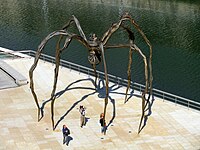
Listing of abstruse expressionists [edit]
Abstract expressionist artists [edit]
- Meaning artists whose mature work defined American abstract expressionism:
Other artists [edit]
- Pregnant artists whose mature piece of work relates to the American abstract expressionist motility:
See besides [edit]
Related styles, trends, schools, and movements [edit]
- Abstruse Fine art
- Abstruse Imagists
- Action painting
- American Abstract Artists
- Arte Povera
- Asemic writing
- CoBrA
- Color field painting
- History of painting
- Informalism
- Les Automatistes
- Les Plasticiens
- Lyrical Abstraction
- Lyricism
- Minimalism
- New European Painting
- New York School
- Organic Surrealism
- ninth Street Fine art Exhibition
- Painters Eleven
- Pop art
- Post-painterly brainchild
- Tachisme
- 10th Street galleries
- The Irascibles
[edit]
- Bluebeard, by Kurt Vonnegut, is a fictional autobiography written by fictional abstract expressionist Rabo Karabekian.
- Ismail Gulgee (artist whose piece of work reflects abstract expressionist influence in Southward Asia during the Cold War, specially 'activity painting')
- Michel Tapié (critic and exhibition organizer important to the dissemination of abstract expressionism in Europe, Japan, and Latin America)
References [edit]
- ^ Editors of Phaidon Press (2001). The 20th-Century art book (Reprinted. ed.). London: Phaidon Press. ISBN0714835420.
- ^ Hess, Barbara; "Abstract Expressionism", 2005
- ^ Andreas Neufert, Auf Liebe und Tod, Das Leben des Surrealisten Wolfgang Paalen, Berlin (Parthas) 2015, Southward. 494ff.
- ^ Barnett Newman Foundation, archive 18/103
- ^ Shapiro, David/Cecile (2000), "Abstruse Expressionism: The politics of apolitical painting." pp. 189–190 In: Frascina, Francis (2000–i): Pollock and After: The Critical Argue. 2nd ed. London: Routledge
- ^ Catherine de Zegher and Hendel Teicher (eds.). 3 X Abstraction. NY: The Drawing Center and /New Haven: Yale Academy Press. 2005.
- ^ Serge Guilbaut. How New York Stole the Idea of Modern Art, University of Chicago Press, 1983.
- ^ Marika Herskovic, Americancan Abstruse Expressionism of the 1950s An Illustrated Survey, (New York Schoolhouse Printing, 2003.) ISBN 0-9677994-i-iv pp12–13
- ^ a b Marika Herskovic, New York School Abstract Expressionists Artists Choice by Artists (New York Schoolhouse Press, 2000.) ISBN 0-9677994-0-6 p.11–12
- ^ Abstract Expressionism, past Barbara Hess, Taschen, 2005, back cover
- ^ Thomas B. Hess, "Willem de Kooning", George Braziller, Inc. New York, 1959 p.13
- ^ Tomkins, Calvin. Off the Wall: A Portrait of Robert Rauschenberg [Deckle Edge] [Paperback], p. 5. Publisher: Picador; Revised and Updated edition (November 29, 2005) ISBN 0-312-42585-6
- ^ Barnett Newman Selected Writings and Interviews, (ed.) by John P. O'Neill, pp. 240–241, University of California Press, 1990
- ^ Barnett Newman Selected Writings Interviews, p. 201.
- ^ Cloudless Greenberg, "Art and Culture Critical essays", ("The Crunch of the Easel Moving-picture show"), Beacon Press, 1961 pp.: 154–57
- ^ Harold Rosenberg, The Tradition of the New, Affiliate 2, "The American Activity Painter", pp.23–39
- ^ Jean Dubuffet: L'Art brut préféré aux arts culturels [1949](=engl in: Fine art brut. Madness and Marginalia, special issue of Fine art & Text, No. 27, 1987, p. 31-33)
- ^ Museum, Solomon R. Guggenheim (December 23, 1953). Younger European painters, a selection.: [Exhibition] December 2, 1953 to February 21, 1954. OL 22161138M – via The Open Library.
- ^ Willem de Kooning (1969) past Thomas B. Hess
- ^ a b c Dorment, Richard. "Arshile Gorky: A Retrospective at Tate Modern, review", The Daily Telegraph, February viii, 2010. Retrieved May 24, 2010.
- ^ Art Daily Archived December 27, 2011, at the Wayback Machine retrieved May 24, 2010
- ^ "L.A. Art Collector Caps Two Year Pursuit of Artist with Exhibition of New Work", ArtDaily. Retrieved May 26, 2010. "Lyrical Brainchild ... has been applied at times to the work of Arshile Gorky"
- ^ "Arshile Gorky: A Retrospective", Tate, February 9, 2010. Retrieved June 5, 2010.
- ^ Van Siclen, Bill. "Fine art scene by Bill Van Siclen: Part-time faculty with total-time talent" Archived June 22, 2011, at the Wayback Automobile, The Providence Journal, July 10, 2003. Retrieved June ten, 2010.
- ^ Chaet, Bernard (1980). "The Boston Expressionist School: A Painter's Recollections of the Forties". Archives of American Art Journal. The Smithsonian Institution. 20 (1): 28. doi:x.1086/aaa.twenty.1.1557495. JSTOR 1557495. S2CID 192821072.
[Thomas] Hess's favorite painter, Willem de Kooning...made it very articulate to me in a chat in 1954 that he and Jackson Pollock considered Flower, whom they had discovered in Americans 1942, 'the first Abstruse Expressionist artist in America.'"
- ^ Hans Hofmann.org/1940-1949,
- ^ Appignanesi, Richard, et al., Introducing Postmodernism, Ikon Books, Cambridge, United Kingdom, 2003, p. thirty
- ^ Nochlin, Linda, Ch.ane in: Women Artists at the Millennium (edited by C. Armstrong and C. de Zegher) MIT Press, 2006.
- ^ Pollock, Griselda, Encounters in the Virtual Feminist Museum: Time, Space and the Archive. Routledge, 2007.
- ^ De Zegher, Catherine, and Teicher, Hendel (eds.), 3 X Abstraction. New Haven: Yale Academy Printing. 2005.
- ^ McNeil, George (2008). George McNeil.
- ^ "Janis Gallery abstruse". New York Magazine. Jan 31, 1972. Retrieved 2016-03-xx .
- ^ Summers, Claude J. (2004). The Queer Encyclopedia of the Visual Arts. ISBN9781573441919.
- ^ Scott, William B.; Rutkoff, Peter M. (August 24, 2001). New York Modern. ISBN9780801867934.
- ^ Rosenberg, Harold. "The American Activity Painters". poetrymagazines.org.uk. Retrieved August twenty, 2006.
- ^ based (very) loosely on a lecture past Fred Orton at the Uni of Leeds and H. Geldzahler, New York Painting and Sculpture: 1940–1970, NY 1969
- ^ "International Paintings and Sculpture – Woman 5". nga.gov.au . Retrieved 2016-03-20 .
- ^ "Painting Number 2 at MoMA".
- ^ Keane, Tim (March xvi, 2013). "Painting at the Speed of Sight: Franz Kline's Rapid Transit". Hyperallergic.
- ^ "Art History Definition: Action Painting". ThoughtCo . Retrieved 2018-05-04 .
- ^ "Franz Kline, Number two (1954), Museum of Modern Art, New York".
- ^ Rudolf Arnheim, The Ability of the Centre: A Study of Composition in the Visual Arts, University of California Press, 1983, pp. 71–72, ISBN 0520050150
- ^ Willette, Jeanne. "Abstract Expressionism: Redefining Fine art, Function One | Art History Unstuffed".
- ^ Metropolitan Museum of Art Heilbrunn Timeline of Art History, Abstract Expressionism
- ^ Metropolitan Museum of Fine art
- ^ "Robert Motherwell. Elegy to the Spanish Commonwealth, 108. 1965-67 | MoMA". The Museum of Modern Art.
- ^ The Aldrich Museum of Contemporary Fine art, Lyrical Abstraction, exhibition: April 5 through June 7, 1970, Statement of the exhibition
- ^ MoMA Learning. "What is Abstract Expressionism: Marking Rothko". Retrieved February 28, 2014.
- ^ Pollock #12 1952 at NY State Mall projection Archived March thirteen, 2014, at the Wayback Machine Retrieved May 6, 2011
- ^ 'Colour Field' Artists Found a Different Way Retrieved August 3, 2010
- ^ Fenton, Terry. "Morris Louis". sharecom.ca. Retrieved December 8, 2008
- ^ De Antonio, Emile (1984), Painters Painting, a Aboveboard History of The Modern Art Scene 1940–1970 , Abbeville Press, p. 79, ISBN0-89659-418-1
- ^ Carmean, Due east. A. (1989), Helen Frankenthaler: A Paintings Retrospective (Exhibition Catalog), in conjunction with The Museum of Modern Art, Fort Worth, Harry Northward. Abrams, pp. 12–twenty, ISBN0-8109-1179-5
- ^ Aldrich, Larry. Young Lyrical Painters, Art in America, v.57, n6, November–Dec 1969, pp.104–113.
- ^ CIA and AbEx Retrieved Nov 7, 2010
- ^ "Worldcatlibraries.org". Worldcatlibraries.org. Retrieved Apr 25, 2012.
- ^ Modern Art was a CIA 'Weapon' Retrieved September 4, 2013
- ^ Kimmelman, Michael; Frascina, Francis, ed. (2000). "Revisiting the Revisionists: The Modernistic, Its Critics and the Cold War". Pollock and After: The Disquisitional Debate. Psychology Press. pp. 294–306. ISBN9780415228664.
- ^ "Abstract Expressionist New York". MoMA. Retrieved March 22, 2012.
- ^ Dore Ashton, American Art Since 1945, Oxford University Press, 1982, p. 37, ISBN 0195203593
- ^ "Charles Henry Alston - Biography". www.askart.com.
- ^ a b c d e f g h i j k l m northward o p q Marika Herskovic, New York Schoolhouse Abstruse Expressionists Artists Selection by Artists, (New York School Press, 2000), ISBN 0-9677994-0-6
- ^ a b c d e f Metropolitan Museum of Art, Heilbrunn Timeline of History
- ^ Cotter, The netherlands (February 6, 1999). "Norman Bluhm Is Dead at 78; Abstruse Expressionist Painter (Published 1999)". The New York Times.
- ^ "Exhibit PREVIEW: Rediscovering David Budd: The Forgotten Abstract Expressionist". ticket.heraldtribune.com.
- ^ "Hans Burkhardt, 89, An Abstruse Painter (Published 1994)". The New York Times. Associated Press. April 24, 1994.
- ^ "Jack Bush-league Online". www.artcyclopedia.com.
- ^ "Lawrence Calcagno Online". www.artcyclopedia.com.
- ^ "Alexander Calder | Artist". ArtFacts.
- ^ Kennedy, Randy (Dec 22, 2011). "John Chamberlain, Who Wrested Crude Magic From Scrap Metallic, Dies at 84 (Published 2011)". The New York Times.
- ^ "Jean Dubuffet: The Terminal Two Years by Donald Kuspit - artnet Mag". www.artnet.com.
- ^ a b "New York Cool: Painting and Sculpture from the NYU Art Collection". Grey Art Gallery.
- ^ Carol Vogel, Works by Johns and de Kooning Sell for $143.5 One thousand thousand, The New York Times, October 12, 2006
- ^ Artdaily
- ^ "Robert de [sic] Niro Sr. Online". www.artcyclopedia.com.
- ^ Kimmelman, Michael (March 31, 1993). "Richard Diebenkorn, Lyrical Painter, Dies at 71 (Published 1993)". The New York Times.
- ^ "Aurora". www.nga.gov.
- ^ "James Budd Dixon | Widewalls". www.widewalls.ch.
- ^ New York School Abstract Expressionists Artists Choice past Artists, (New York School Press, 2000.) ISBN 0-9677994-0-6 pp.20–21
- ^ "Herbert Ferber Online". www.artcyclopedia.com.
- ^ "John Ferren Online". world wide web.artcyclopedia.com.
- ^ a b Brooks, Katherine (June 28, 2016). "12 Women Of Abstract Expressionism History Should Not Forget". HuffPost.
- ^ Wood, Jim (October 2007). "Sam Francis: The internationally acclaimed abstract expressionist spent his final days in West Marin". Marin Magazine. Archived from the original on June 12, 2008.
- ^ "Artist Showdown: Jane Frank".
- ^ Feaver, William. "The mysterious art of Arshile Gorky", The Guardian, February 6, 2010. Retrieved June ten, 2010.
- ^ "Adolph Gottlieb | artnet". www.artnet.com.
- ^ "Morris Graves Online". www.artcyclopedia.com.
- ^ "Cleve Grayness Online". world wide web.artcyclopedia.com.
- ^ "Philip Guston 1913–1980". Tate.
- ^ Smith, Roberta (February 18, 1993). "Raoul Hague, Sculptor, 88, Dies; Abstract Expressionist in Wood (Published 1993)". The New York Times.
- ^ "David Hare; Sculptor, Painter". Los Angeles Times. December 28, 1992.
- ^ Grimes, William (2008-11-18). "Grace Hartigan, 86, Abstruse Painter, Dies". The New York Times. ISSN 0362-4331. Retrieved 2018-02-17 .
- ^ "THE ARTIST". HANS HOFMANN.
- ^ "UB Anderson Gallery to Present John Hultberg: Vanishing Point". www.buffalo.edu.
- ^ Kennedy, Randy (June 17, 2012). "Paul Jenkins, Painter of Abstract Artwork, Dies at 88 (Published 2012)". The New York Times.
- ^ https://www.metmuseum.org/art/collection/search/485379
- ^ Baker, Kenneth (March 30, 2009). "Walter Kuhlman dies - abstruse expressionist". SFGATE.
- ^ "Ibram Lassaw Online". www.artcyclopedia.com.
- ^ Sobieski, Elizabeth (April three, 2014). "Alfred Leslie: The Last of the Really Great Abstract Expressionists, Now a Master of 21st Century Digital Art". HuffPost.
- ^ "Norman Lewis / American Art". americanart.si.edu . Retrieved 2015-06-04 .
- ^ "ABSTRACT EXPRESSIONISM: HUMANOID SCULPTURE FROM THE 3RD DIMENSION". Los Angeles Times. January 13, 1985.
- ^ James, George (December 7, 1986). "SEYMOUR LIPTON DIES; A Cocky-TAUGHT SCULPTOR (Published 1986)". The New York Times.
- ^ Jesse Hamlin, 'Frank Lobdell, influential Bay Area painter, dies', SF Gate, Th, 19 December 2013; retvd. 29 July 2014
- ^ "Morris Louis".
- ^ Kimmelman, Michael (August 31, 2000). "Conrad Marca-Relli, Collagist and Painter, Is Dead at 87 (Published 2000)". The New York Times.
- ^ "Roosevelt Constitute".
- ^ "Hugh Mesibov Biography". hughmesibov.com.
- ^ Herskovic, Marika, New York school : abstract expressionists : artists choice by artists: a consummate documentation of the New York painting and sculpture annuals, 1951-1957, New Jersey: New York Schoolhouse Printing, 2000, p.253
- ^ Brenson, Michael (November 3, 1989). "Review/Art; An Art of Motion: Joan Mitchell'due south Abstract Expressionism". The New York Times . Retrieved November 23, 2012.
- ^ Glueck, Grace (July eighteen, 1991). "Robert Motherwell, Master of Abstract, Dies (Published 1991)". The New York Times.
- ^ "Read the Latest from the Broad Strokes Blog".
- ^ Temkin, Ann (March i, 2002). "A Giant Zip for Mankind".
- ^ "ArtAsiaPacific: Abstract Expressionism Looking Due east From The Far West". artasiapacific.com.
- ^ "The Phillips Collection".
- ^ "John Opper, 85, Abstract Painter (Published 1994)". The New York Times. October 7, 1994.
- ^ Helen Harrison (2002-12-08). "Arts & Entertainment: Art Reviews; Landscapes of Fantasy, and a Devotion to Colour 'Three E End Artists'". The New York Times. New York, New York. p. LI21.
This body of her work has not been seen in depth for many years, and it confirms her status as a New York Schoolhouse abstractionist of the first rank. Seldom does a painter have such control over intense color – for instance ion 'No.half-dozen (Montauk),' in which the sharpness of complementary contrasts is subtly muted and harmonized. Complex interactive layering animates the painted surfaces, which ofttimes conceal every bit much equally they reveal. Organic and calligraphic shapes jockey for position, nevertheless are held firmly in identify past implicit construction. These are not mere virtuoso formal exercises, notwithstanding; their emotional undercurrents are as potent as their technical qualities.
- ^ "Untitled » Norton Simon Museum". www.nortonsimon.org.
- ^ "You are being redirected..." ctstatelibrary.org.
- ^ "Ad Reinhardt | Smithsonian American Art Museum". americanart.si.edu.
- ^ Smith, Roberta (March xix, 2004). "Milton Resnick, Abstract Expressionist Painter, Dies at 87 (Published 2004)". The New York Times.
- ^ Johnson, Ken (July 21, 2002). "George Rickey, Sculptor Whose Works Moved, Dies at 95 (Published 2002)". The New York Times.
- ^ "Jean-Paul Riopelle, 78; Canadian Abstract Expressionist Painter". Los Angeles Times. March 16, 2002.
- ^ "Britannica".
- ^ Zenobia Grant Wingate. "Ralph Rosenborg". Caldwell Gallery . Retrieved 2019-06-eighteen .
- ^ Dudar, Helen. "Picturing the American Century". Smithsonian Magazine.
- ^ "Anne Ryan". The New Yorker.
- ^ Grimes, William (October 9, 2009). "Charles Seliger, Abstract Expressionist, Dies at 83 (Published 2009)". The New York Times.
- ^ "David Smith | Widewalls". www.widewalls.ch.
- ^ "The Phillips Collection". Archived from the original on May 7, 2015. Retrieved July 12, 2018.
- ^ "Richard Stankiewicz Online". world wide web.artcyclopedia.com.
- ^ "Joe Stefanelli | InLiquid". October 28, 1989.
- ^ Art Daily, Hedda Sterne, America'due south Last Original Abstract Expressionist and Sole Woman in the Grouping, Dies Retrieved Apr ten, 2011
- ^ "Clyfford Still". The Phillips Collection. Archived from the original on January 22, 2010. Retrieved 21 October 2014.
- ^ "Sausalito historical order".
- ^ "Alma Thomas: an abstract expressionist and black artist, who fiercely resisted any labels". America Magazine. September 22, 2016.
- ^ "Mark Tobey Biography - Infos for Sellers and Buyers". www.mark-tobey.com.
- ^ "Phillips Collection". Archived from the original on December 13, 2017. Retrieved July 7, 2018.
- ^ Matt Schudel (July 6, 2011), Cy Twombly, influential Va.-born abstract creative person, dies at 83 Washington Post.
- ^ "Jack Tworkov | artnet". www.artnet.com.
- ^ SMITH, ROBERTA (2001-01-12). "Esteban Vicente Dies at 97; An Abstruse Expressionist". The New York Times . Retrieved May 1, 2010.
- ^ "Untitled (Stack) past Peter Voulkos" (February 1, 2012). De Young Museum. deyoung.famsf.org. Retrieved 2017-01-02.
- ^ "A woman painting in a human being'due south globe". Orange Canton Register. 9 June 2010. Retrieved 2 November 2014.
- ^ "John von Wicht, Painter, Dead; His Works in Leading Museums (Published 1970)". The New York Times. Jan 23, 1970.
- ^ "Hale Woodruff | Smithsonian American Fine art Museum". americanart.si.edu.
- ^ "Emerson Woelffer | artnet". world wide web.artnet.com.
- ^ Marika Herskovic, New York School Abstruse Expressionists Artists Choice by Artists, (New York School Press, 2000.) ISBN 0-9677994-0-half dozen. p. 33; p. 39; p. 378–381
- ^ "A Family of Artists: Yektai Father and Sons Share Gallery Space at Lodge Hall | Hamptons Art HubHamptons Art Hub". hamptonsarthub.com. Dec 8, 2017.
- ^ "Mino Argento" Betty Parsons Gallery. Arts magazine – Volume 52, Function 1 – Page thirteen
- ^ Pattan, South. F. (1998) African American Art, New York: Oxford Academy Press
Books [edit]
- Belgrad, Daniel. The Culture of Spontaneity. Improvisation and the Arts in Postwar America University of Chicago Press, Chicago & London, 1998. ISBN 978-966-359-305-0
- Anfam, David. Abstruse Expressionism (New York & London: Thames & Hudson, 1990). ISBN 0-500-20243-five
- Chicken, David, Abstract expressionism every bit cultural critique: dissent during the McCarthy menstruation (Cambridge; New York: Cambridge University Press, 1999.) ISBN 0-521-43415-7
- Marika Herskovic, American Abstract and Figurative Expressionism: Style Is Timely Fine art Is Timeless (New York Schoolhouse Press, 2009.) ISBN 978-0-9677994-2-1
- Marika Herskovic, American Abstract Expressionism of the 1950s An Illustrated Survey, (New York School Printing, 2003.) ISBN 0-9677994-1-iv
- Marika Herskovic, New York Schoolhouse Abstract Expressionists Artists Option by Artists, (New York School Press, 2000.) ISBN 0-9677994-0-vi
- Papanikolas, Theresa and Stephen Salel, Stephen, Abstruse Expressionism, Looking E from the Far West, Honolulu Museum of Art, 2017, ISBN 9780937426920
- Serge Guilbaut. How New York Stole the Thought of Mod Art, Academy of Chicago Press, 1983.
Bibliography [edit]
- Anfam, David. Abstruse Expressionism—A World Elsewhere. New York: Haunch of Venison, 2008, Haunchofvenison.com
- Greenberg, Clement. "'American-Type' Painting". In Fine art and Culture: Disquisitional Essays. Boston: Beacon Press, 1961. 208–29.
- Jachec, Nancy. The Philosophy and Politics of Abstract Expressionism 1940–1960. Cambridge University Printing: Cambridge, 2000 ISBN 0-521-65154-9
- O'Connor, Francis 5. Jackson Pollock [exhibition catalogue] (New York, Museum of Modern Art, [1967]) OCLC 165852
- Saunders, Frances Stonor, The cultural cold war: the CIA and the world of arts and messages (New York: New Press: Distributed by Due west.W. Norton & Co., 2000) ISBN 1-56584-596-Ten
- Tapié, Michel. Hans Hofmann: peintures 1962 : 23 avril-xviii mai 1963. (Paris: Galerie Anderson-Mayer, 1963.) [exhibition catalogue and commentary] OCLC 62515192
- Tapié, Michel. Pollock (Paris, P. Facchetti, 1952) OCLC 30601793
- Wechsler, Jeffrey (2007). Pathways and Parallels: Roads to Abstruse Expressionism. New York: Hollis Taggart Galleries. ISBN978-0-9759954-ix-5.
External links [edit]
- Jackson Pollock
- Louis Schanker
- Philip Guston
- Perle Fine
- Perle Fine Abstract Expressionism-1950s New York action painter' on YouTube
- Albert Kotin
- Albert Kotin Abstract Expressionism 1950s-New York Schoolhouse 1950s activeness painting on YouTube
- James Brooks Abstract Expressionist painter 1906–1992
- James Brooks Abstruse Expressionsim-New York School 1950s on YouTube
- American Abstract Artists
- First of the New York School 1950s-Abstract Expressionism of the 1950s on YouTube
- Clyfford Still Museum
- Abstract expressionism 1950s-New York School Artists of the 9th St Evidence Reminisce on YouTube
- 9th Street Art Exhibition-abstract expressionist artists reminisce on YouTube
- Nicolas Carone-Abstract Expressionism-Artist of the ninth St. Evidence on YouTube
- Conrad Marca-Relli Abstruse Expressionism 1950s-New York School collage-painter on YouTube
- Robert Richenburg Abstract Expressionism 1950s-New York Schoolhouse 1950s on YouTube
- Joe Stefanelli Abstruse Expressionism 1950s-New York School 1950s on YouTube
- What is Abstract Expressionism? on YouTube
Source: https://en.wikipedia.org/wiki/Abstract_expressionism
0 Response to "When Did the Center of the Western Art World Shift From Europe to the United States"
Post a Comment